Week 3
Straight-Line
Assimilation Theory
Soci—231
A Linear View of Assimilatory Change–
September 15th
Updates/Reminders
Response Memos Are Due Tonight
Response Memo Deadline
Memos for Week 3 are due by 8:00 PM tonight.
Updates/Reminders
A Note on Office Hours
Week 3 Office Hours
This week, I will be available from 3:00 to 5:00 PM on Thursday.
I will not be available on Friday.
Updates/Reminders
An Invitation
Click to Expand Invitation

A Crude Model and Some Context on Yankee City
Another Conceptual Sketch
Straight Line Assimilation
Click to Expand .gif
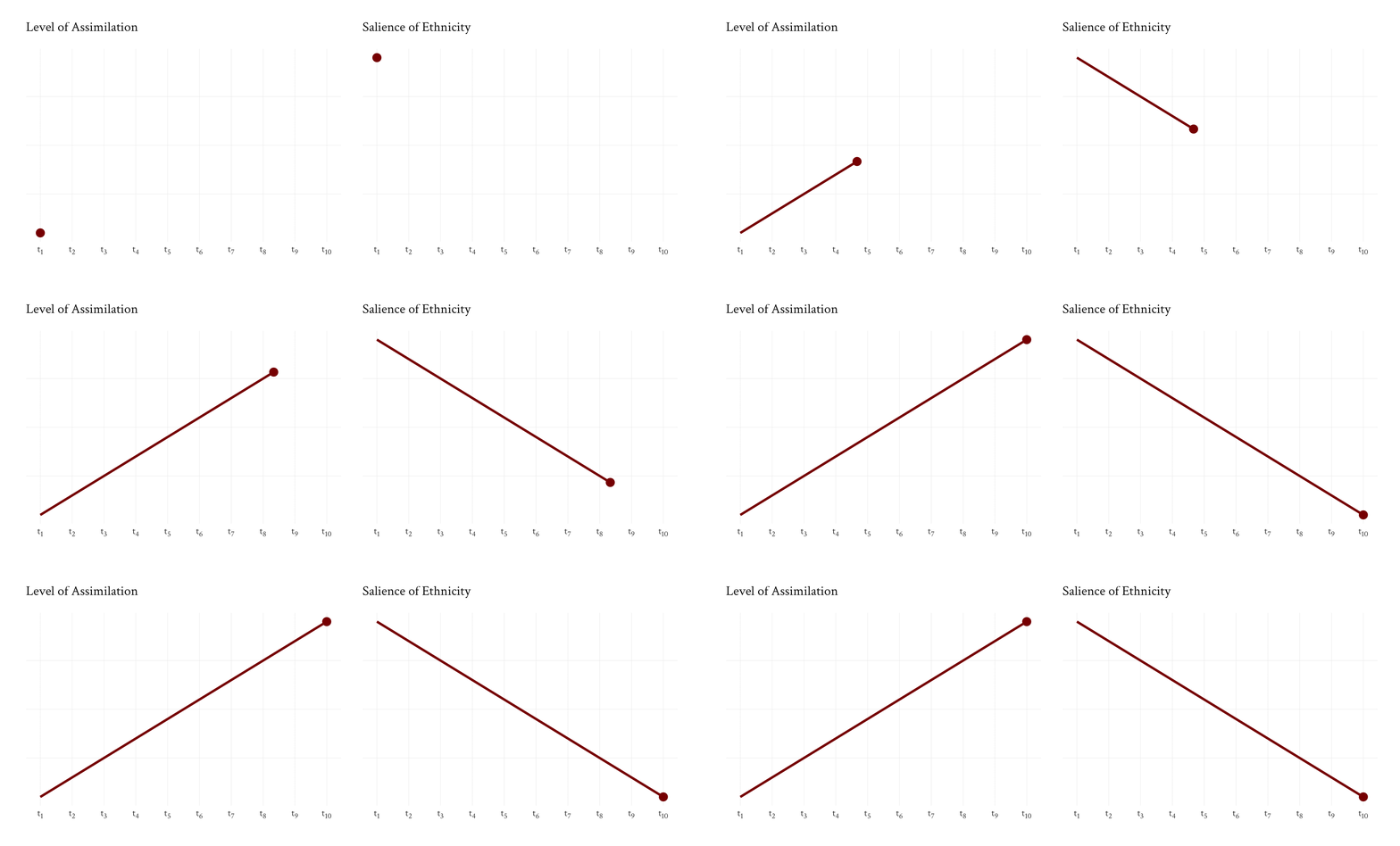
Yankee City
Warner and Srole’s (1945) classic treatise took place in
Yankee City, New England.
The Social Systems of American Ethnic Groups
(Warner and Srole 1945)
A High-Level Overview
Warner and Srole conclude that American ethnic groups are destined to be no more than temporary phenomena, doomed by the egalitarian values of the United States and by widespread social mobility … Exhibited here are some of the features of the old assimilation conception that scholars now vigorously reject in relation to new immigrants and their American-born children. One is the seeming inevitability of assimilation, which is presented as the natural end point of the process of incorporation into American society … Further, by equating assimilation with full or successful incorporation, these and other earlier writers viewed African Americans and other racial minorities as, in effect, incompletely assimilated, rather than as incorporated into the society on some other basis.
(Alba and Nee 2003:2–3, EMPHASIS ADDED).
The Basic Story
This book tells part of the magnificent history of the adjustment of the ethnic groups to American life. What has happened in Yankee City illustrates much of what has happened and is happening to the “minority groups” all over America. Each group enters the city at the bottom of the social heap (lower- lower class) and through the several generations makes its desperate climb upward. The early arrivals, having had more time, have climbed farther up the ladder than the ethnic groups that followed them.
(Warner and Srole 1945:2, EMPHASIS ADDED)
The Basic Story
Many of the children’s children of the early arrivals have ceased participating in the ethnic life of their ancestors and have disappeared in the larger American world. Others are on their way to assimilation. Some, partly through frustration in not gaining easy acceptance into the common life of Americans and partly through clinging to the ways of their fathers, have constructed separate social worlds of their own.
(Warner and Srole 1945:2–3, EMPHASIS ADDED)
The Basic Story
The roots of the minorities of Europe are buried deeply in the soil of the dominant country. Often the history of the subordinate group in a region is more ancient than that of the dominant one. In the United States … [b]oth the immigrant and host societies know that the so-called “old-American” culture is itself new and ultimately “immigrant.” This feeling creates a certain toleration in the attitude of the host society.
(Warner and Srole 1945:283, EMPHASIS ADDED)
A Question
What do the last three excerpts reveal about Warner and Srole’s (1945) theory of assimilation?
Rapid Response Institutional Foundations of Assimilation
Institutional Foundations of Assimilation
Political Structure
The forces which are most potent both in forming and changing the ethnic groups emanate from the institutions of the dominant American social system. Our political organization permits all adults to be equal within its structure. Although at first this equality is largely theoretical, it gives the ethnic members an attainable goal as the political success of the Irish, Germans, Scandi navians, and Italians demonstrates.
(Warner and Srole 1945:283, EMPHASIS ADDED)
Institutional Foundations of Assimilation
Political Structure
Interpret the preceding excerpt.
Institutional Foundations of Assimilation
Economic Structure
Our developing industrial and factory economy with its own hierarchy permits and demands that ethnic members move up and out of their ethnic subsystems into the common life of America.
(Warner and Srole 1945:283, EMPHASIS ADDED)
Institutional Foundations of Assimilation
Economic Structure
Interpret the preceding excerpt.
Institutional Foundations of Assimilation
Educational System
The public school teaches the people to adjust to the central core of our life, provides them with technical skills for their own advancement, and gives them some of the power necessary to become upward mobile in our class order. The school, in belief and partly in practice, expresses the basic principles of American democracy where all men are equal; when the school cannot make them equal it struggles to make them culturally alike.
(Warner and Srole 1945:283–84, EMPHASIS ADDED)
Institutional Foundations of Assimilation
Educational System
Interpret the preceding excerpt.
Institutional Foundations of Assimilation
Marriage and Family
The American family system breaks down and builds up ethnic subsystems. The ethnic parent tries to orient the child to an ethnic past, but the child often insists on being more American than Americans. Marriage also may maintain or disrupt the ethnic way of life. At marriage an individual may move out of his ethnic group into that of his spouse; or an individual who has become partly American may re-identify with his ethnic group and become more ethnic than in the past.
(Warner and Srole 1945:284, EMPHASIS ADDED)
Institutional Foundations of Assimilation
Marriage and Family
Interpret the preceding excerpt.
Institutional Foundations of Assimilation
Social Networks
Cliques and associations also operate to increase or decrease ethnic identification. If the child in school becomes a part of an American clique he is likely to move rather rapidly into the American way of life. On the other hand, if he is rejected and forced to participate in ethnic cliques he may become closely identified with the cultural group of his parent. This is also true for adult cliques and for adult associations.
(Warner and Srole 1945:284, EMPHASIS ADDED)
Institutional Foundations of Assimilation
Social Networks
Interpret the preceding excerpt.
Institutional Foundations of Assimilation
Class System
Our class system functions for a large proportion of ethnics to destroy the ethnic subsystems and to increase assimilation. The mobile ethnic is much more likely to be assimilated than the non mobile one. The latter retains many of the social characteristics of his homeland. Most ethnics are in lower social levels. Some of them become self-sufficient, interact among themselves, and thereby reinforce their old ways of life. Some of the unsuccessfully mobile turn hostile to the host culture, develop increased feelings of loyalty to their ethnic traditions, become active in maintaining their ethnic subsystems, and prevent others from becoming assimilated. But, generally speaking, our class order disunites ethnic groups and accelerates their assimilation.
(Warner and Srole 1945:284, EMPHASIS ADDED)
Institutional Foundations of Assimilation
Class System
Interpret the preceding excerpt.
Constraints on Assimilation
Impediments to Ethnic Decay
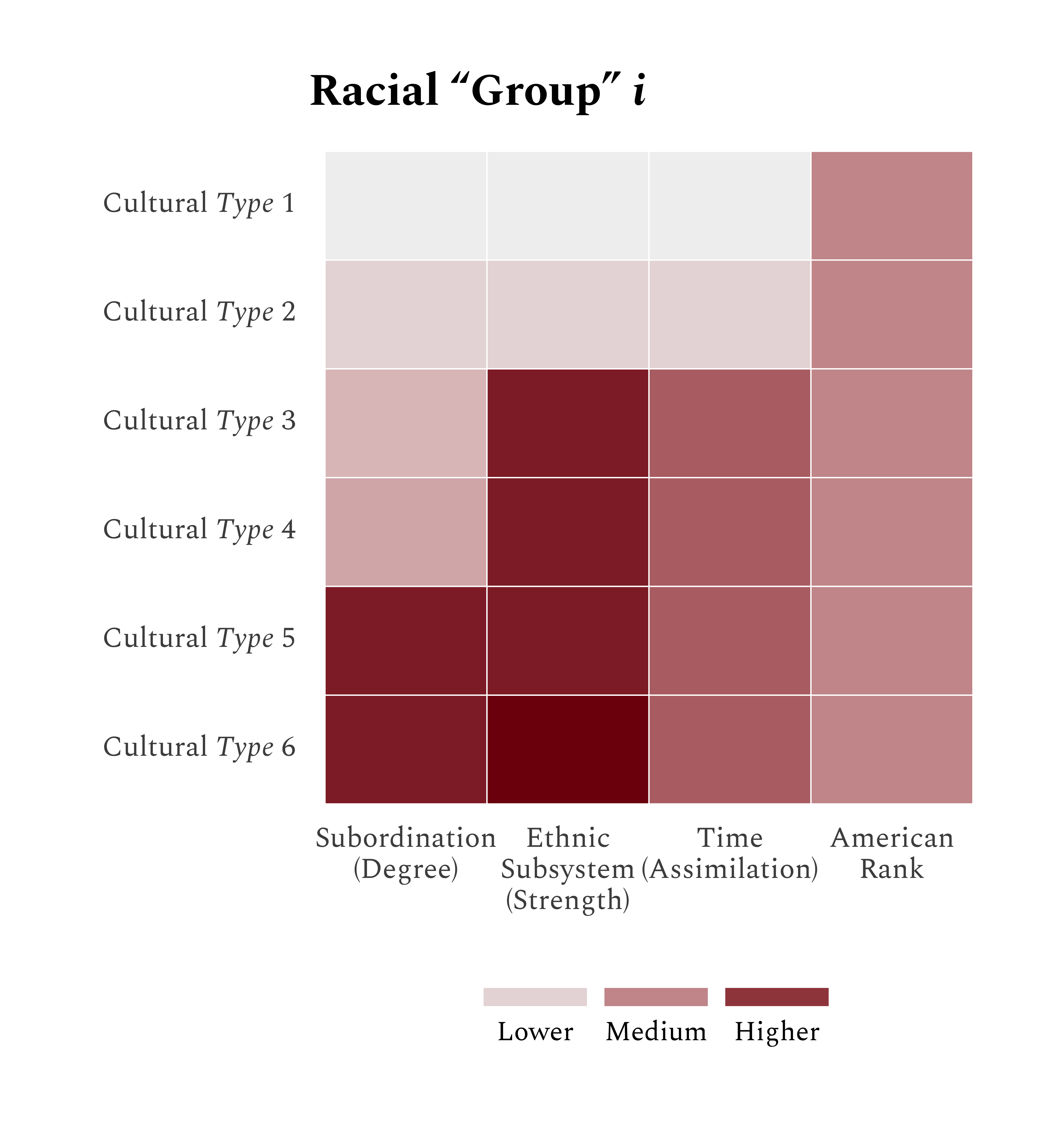
According to Warner and Srole (1945)
Cultural Distance
Racial Difference
Interactions Between (1) and (2)
A Question
What do I mean by interactions?
Impediments to Ethnic Decay
According to Warner and Srole (1945)
These factors yield a matrix of assimilatory possibilities or pathways for different “ethnic groups.”
Click to Expand Image
Impediments to Ethnic Decay
According to Warner and Srole (1945)
How can we make sense of this matrix?
An Interpretation
To Warner and Srole (1945), so-called ethnic groups that are more socially distant from the American core should take more time to assimilate—but assimilation is inevitable.
Impediments to Ethnic Decay
According to Warner and Srole (1945)
How can we critique this matrix?
The Straight-Line Thesis
Straight-Line Assimilation
The future of American ethnic groups seems to be limited; it is likely that they will be quickly absorbed. When this happens one of the great epochs of American history will have ended … [T]he force of American equalitarianism, which attempts to make all men American and alike, and the force of our class order, which creates differences among ethnic peoples, have combined to dissolve our ethnic groups.
(Warner and Srole 1945:295–96, EMPHASIS ADDED)
Straight-Line Assimilation
Despite the uncertainty about the prospects for assimilation of nonwhites and some Jews, … [Warner and Srole’s (1945) …] assumption that assimilation was the point on the horizon toward which all groups were moving, albeit in some cases with glacial slowness, was unquestioned.
(Alba and Nee 2003:21, EMPHASIS ADDED)
Group Discussion
Concretizing the Metaphor
In small groups, carefully explain why Warner and Srole’s (1945) treatment of assimilation is associated with the
straight line metaphor.
The Canonical Theory–
September 17th
The Path Forward
Some Definitional Work
Assimilation in American Life
(Gordon 1964)
The Canonical Treatment
The problem of disentangling the strands associated with assimilation to reveal its distinct elements and thereby fashion a set of operational concepts with analytic value in a broad range of research settings was not solved until Milton Gordon’s Assimilation in American Life (1964) … It is with his book that a canonical account takes on a sharply etched conceptual profile.
(Alba and Nee 2003:23, EMPHASIS ADDED)
The Nature of Assimilation
With regard to the term “assimilation” … there is a certain amount of confusion, and there is, further, a compelling need for a rigorous and systematic analysis of the concept of assimilation which would “break it down” into all the possible relevant factors or variables which could conceivably be included under its rubric. Such an analysis … will be attempted here.
(Gordon 1964:61, EMPHASIS ADDED)
Existing Understandings (Pre-1964)
In the third chapter of Assimilation in American Life, Gordon (1964) begins with a broad overview of how scholars conceptualized assimilation—as well as its analogue, acculturation A kindred concept we will explore in detail in a few short weeks.—in the midcentury.
Existing Understandings (Pre-1964)
To this end, he reviews definitions sketched by—
Existing Sources
The Social Science Research Council’s Subcommittee on Acculturation
Robert E. Park and Ernest W. Burgess
Edward Byron Reuter
Henry Pratt Fairchild
Brewton Berry
Joseph H. Fichter
John Cuber
William S. Bernard
Group Discussion II
Reviewing Pre-1964 Definitions
In groups of 2-3, carefully review the definitions of assimilation invoked by Gordon (1964:61–68).
How would you summarize the development of assimilation theory from its origins at the turn of the 20th century to the early-1960s? Moreover, what was—per Gordon (1964)—missing in existing definitional statements?
Answering the Final Question
To be blunt: rigour and analytic precision. Gordon’s (1964:68) goal is, in part, to integrate pre-1964 definitions to concretely “specify the major variables or factors” undergirding assimilation in America.
An Ideal-Typical Example
A Stylized Example
Imagine a relatively homogeneous (fictional) country,
Sylvania.
A Stylized Example
“Into this country, through immigration, comes a group of people who differ in previous national background and in religion and who thus have different cultural patterns from those of the host society. We shall call them the Mundovians”
(Gordon 1964:69, EMPHASIS ADDED)
A Stylized Example
Let’s assume that in one generation, second generation
Mundovians have:
Wholly adopted the cultural patterns of Sylvanians.
Stopped identifying as Mundovian.
Adopted the Sylvanian religion.
Exited ethnically Mundovian organizations.
Were accepted, without prejudice, into the social networks of Sylvanians.
Often married “ethnic” Sylvanians.
Reported no value conflicts with other Sylvanians.
Implications
“Such a situation would represent the ultimate form of assimilation—complete assimilation to the culture and society of the host country.”
(Gordon 1964:69, EMPHASIS ADDED)
A Stylized Example
Looking at this example, we may discern that seven major variables are involved in the process discussed—in other words, seven basic subprocesses have taken place in the assimilation of the Mundovians to Sylvanian society.
(Gordon 1964:69–70, EMPHASIS ADDED)
Gordon’s Seven Assimilation Variables
The Assimilation Variables
Adapted from Table 5 in Gordon (1964)
The Assimilation Variables
Adapted from Table 6 in Gordon (1964)
Relationships Among Variables
1 ) [C]ultural assimilation, or acculturation, is likely to be the first of the types of assimilation to occur when a minority group arrives on the scene; and 2) cultural assimilation, or acculturation, of the minority group may take place even when none of the other types of assimilation occurs simultaneously or later, and this condition of “acculturation only” may continue indefinitely.
(Gordon 1964:77, EMPHASIS ADDED)
Relationships Among Variables
As we examine the array of assimilation variables again, several other relationships suggest themselves. One is the indissoluble connection, in the time order indicated, between structural assimilation and marital assimilation. That is, entrance of the minority group into the social cliques, clubs, and institutions of the core society at the primary group level inevitably will lead to a substantial amount of intermarriage.
(Gordon 1964:80, EMPHASIS ADDED)
Relationships Among Variables
A Focused Example, cf. Gordon (1964)
Consequences of Marital Assimilation
Loss of ethnic identity and the emergence of identificational assimilation.
Then, the disappearance of prejudice and discrimination — markers of attitude receptional assimilation and behaviour receptional assimilation.
As well as the disappearance of value conflicts—i.e., civic assimilation.
Relationships Among Variables
We may state the emergent generalization … as follows: Once structural assimilation has occurred, either simultaneously with or subsequent to acculturation, all of the other types of assimilation will naturally follow.
(Gordon 1964:81, EMPHASIS ADDED)
A Core American Culture?
The “Core Culture”
In the case of Mundovians in Sylvania …
[T]here has been assimilation in all respects to the society and culture which had exclusively occupied the nation up to the time of the immigrants’ arrival. In other instances there may be other subsocieties and subcultures already on the scene when the new group arrives but one of these subsocieties and its way of life is dominant by virtue of original settlement, the preemption of power, or overwhelming predominance in numbers.
(Gordon 1964:72, EMPHASIS ADDED)
The “Core Culture”
A New Term
In both cases we need a term to stand for the dominant subsociety which provides the standard to which other groups adjust or measure their relative degree of adjustment. We have tentatively used the term “host society”; however, a more neutral designation would be desirable.
(Gordon 1964:72, EMPHASIS ADDED)
The “Core Culture”
A New Term
A. B. Hollingshead, in describing the class structure of New Haven, has used the term “core group” to refer to the Old Yankee families of colonial, largely Anglo-Saxon ancestry who have traditionally dominated the power and status system of the community, and who provide the “master cultural mould” for the class system of the other groups in the city. Joshua Fishman has referred to the “core society” and the “core culture” in American life, this core being “made up essentially of White Protestant, middle-class clay, to which all other particles are attracted.”
(Gordon 1964:72, EMPHASIS ADDED)
The “Core Culture”
A New Term
If there is anything in American life which can be described as an over-all American culture which serves as a reference point for immigrants and their children, it can best be described, it seems to us, as the middle-class cultural patterns of, largely, white Protestant, Anglo-Saxon origins, leaving aside for the moment the question of minor reciprocal influences on this culture exercised by the cultures of later entry into the United States, and ignoring also, for this purpose, the distinction between the upper-middle class and the lower-middle class cultural worlds.
(Gordon 1964:73, EMPHASIS ADDED)
The “Core Culture”
A One-Way Street
The qualitative record of achievement in industry, business, the professions, and the arts by Americans whose ancestors came from countries and traditions which are not British, or in many cases not even closely similar to British, is an overwhelmingly favorable one, and with reference to many individuals, a thoroughly brilliant one.
(Gordon 1964:73, EMPHASIS ADDED)
The “Core Culture”
A One-Way Street
[H]owever … with some exceptions, as the immigrants and their children have become Americans, their contributions, as laborers, farmers, doctors, lawyers, scientists, artists, etc., have been made by way of cultural patterns that have taken their major impress from the mould of the overwhelmingly English character of the dominant Anglo-Saxon culture or subculture in America, whose dominion dates from colonial times and whose cultural domination in the United States has never been seriously threatened.
(Gordon 1964:73, EMPHASIS ADDED)
The “Core Culture”
A Counterfactual
Let’s imagine another outcome for Mundovians in Sylvania where —
Sylvanians adopted many of the Mundovians’ cultural patterns.
The Mundovians changed many of their ways pursuant to Sylvanian customs and traditions.
A new, syncretized cultural system emerged that is not reducible to Sylvanian or Mundovian cultural elements—but a mixture of the two.
Here, we have a realization of the melting pot “goal-system.”
The “Core Culture”
A Counterfactual
Whether such a process as just described is feasible or likely of occurrence is beside the point here. It, too, is an “ideal type,” an abstraction against which we can measure the realities of what actually happens. Our point is that the seven variables of the assimilation process which we have isolated can be measured against the “melting pot” goal as well as against the “adaptation to the core society and culture” goal.
(Gordon 1964:74, EMPHASIS ADDED)
The “Core Culture”
Gordon’s Thoughts on the Melting Pot
[R]ather than an impartial melting of the divergent cultural patterns from all immigrant sources, what has actually taken place has been more of a transforming of the later immigrant’s specific cultural contributions into the Anglo-Saxon mould. As George Stewart has put it, a more accurate figure of speech to describe the American experience would be that of a “transmuting pot” in which “as the foreign elements, a little at a time, were added to the pot, they were not merely melted but were largely transmuted, and so did not affect the original material as strikingly as might be expected.”
(Gordon 1964:127–28, EMPHASIS ADDED)
The “Core Culture”
Gordon’s Thoughts on the Melting Pot
Both structurally and culturally, then, the “single melting pot” vision of America has been something of an illusion—a generous and idealistic one, in one sense, since it held out the promise of a kind of psychological equality under the banner of an impartial symbol of America larger than the symbols of any of the constituent groups—but one which exhibited a considerable degree of sociological naiveté.
(Gordon 1964:129, EMPHASIS ADDED)
The “Core Culture”
Gordon’s Thoughts on the Melting Pot
Given the prior arrival time of the English colonists, the numerical dominance of the English stock, and the cultural dominance of Anglo-Saxon institutions, the invitation extended to non-English immigrants to “melt” could only result, if thoroughly accepted, in the latter’s loss of group identity, the transformation of their cultural survivals into Anglo-Saxon patterns, and the development of their descendants in the image of the Anglo-Saxon American.
(Gordon 1964:129, EMPHASIS ADDED)
The “Core Culture”
Gordon’s Thoughts on the Melting Pot
“Culturally, this process of absorbing Anglo-Saxon patterns has moved massively and inexorably, with greater or lesser speed, among all ethnic groups.”
(Gordon 1964:129, EMPHASIS ADDED)
Group Discussion III
Gordon’s Framework
In small groups, discuss how might measure each dimension of assimilation embedded in Gordon’s (1964) analytic scheme.
After doing so, discuss whether you think these dimensions (and measures) are sufficient for capturing the process of assimilation—i.e., according to your definition of the concept.
See You Tuesday
References